
A painful or unstable knee replacement does not automatically need to be removed. You will learn how to recognise urgent warning signs, identify the likely failure mechanism, compare treatment options, and verify whether a surgeon has the specific revision-arthroplasty experience your case requires.
Key takeaways
- Pain after knee replacement does not prove implant failure.
- Request X-rays, infection tests, and hip and spine assessment before revision surgery.
- Full revision replaces multiple components when loosening, instability, or severe wear affects the knee.
- Compare revision experience, implant options, rehabilitation plans, and complication management before choosing a doctor.
Which Knee Replacement Implant Problems Cause Pain or Instability?
Possible knee replacement implant problems produce distinct symptom patterns, so pain alone does not prove failure. Increasing pain during weight-bearing can reflect loosening, polyethylene wear, malalignment, or a fracture around the implant. Lumbar radiculopathy, hip disease, tendinitis, bursitis, venous thrombosis, and referred pain can mimic implant failure.
Do not revise a knee merely because the implant is old or the knee hurts; identify the mechanism first.
| Pattern | Possible cause | Clues |
|---|---|---|
| Weight-bearing pain | Loosening, polyethylene wear, malalignment, or fracture | Pain rises while standing or walking; sudden inability to bear weight suggests fracture or major failure |
| Rest or night pain | Infection or severe loosening | Persistent pain, swelling, warmth, or reduced function |
| Swelling, warmth, or wound drainage | Periprosthetic joint infection | Drainage is especially concerning, even without severe pain |
| Clicking, giving way, or recurrent dislocation | Instability, malalignment, or component wear | The knee feels unreliable or slips during movement |
| Stiffness or reduced range of motion | Scar tissue, infection, malposition, or wear | Difficulty bending or fully straightening the knee |
- Fever with a hot, swollen knee
- Wound drainage or rapidly increasing pain
- New calf swelling, chest pain, or shortness of breath
These warning signs can indicate infection, fracture, venous thrombosis, or a pulmonary embolism. A clinician can distinguish implant-related disease from spine, hip, tendon, bursal, or vascular pain through examination and imaging.
How Doctors Confirm the Cause Before Revision Knee Surgery
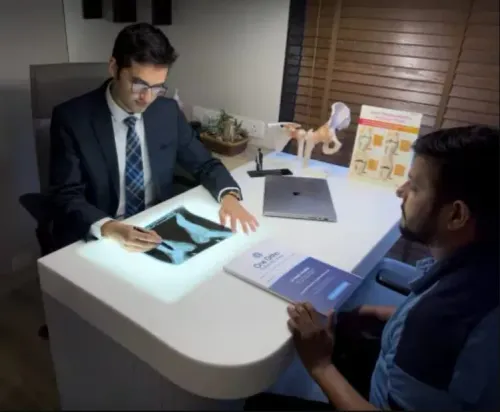
A painful knee replacement needs a cause, not an automatic operation. Bring the original operation report, implant stickers or model and serial or lot information, prior culture results, earlier X-rays, and a timeline of pain, swelling, instability, fever, wound problems, and antibiotic use to your revision knee surgery doctor.
1. The examination checks gait, alignment, warmth, swelling, tenderness, range of motion, ligament stability, extensor function, hip, spine, and circulation. Standing knee radiographs and a long-leg alignment view show migration, wear, malalignment, fracture, or bone loss. Comparing them with older images reveals gradual loosening or changing alignment that one X-ray can miss.
2. Blood tests usually include erythrocyte sedimentation rate (ESR) and C-reactive protein (CRP). Normal results do not exclude low-grade periprosthetic joint infection. If infection is possible, aspirate the joint for synovial white-cell count, differential, culture, and relevant biomarkers such as alpha-defensin when available.
3. The 2018 evidence-based definition combines major and minor criteria, including a sinus tract, cultures, serum markers, synovial tests, and histology. No single negative test proves that the implant is clean. Avoid antibiotics before aspiration when clinically safe because they can reduce culture yield; sepsis requires urgent treatment instead.
4. CT helps assess component rotation, subtle loosening, an occult fracture, or bone loss. Nuclear imaging is reserved for selected unresolved cases. During revision, surgeons take multiple intraoperative tissue cultures: a loose implant is not always infected, and an infected implant is not always loose.
When Is Full Revision Total Knee Replacement the Right Treatment?
A painful knee should not be revised because the implant is old or because pain exists. Confirm the failure mechanism first. Without a draining sinus, acute fracture, gross instability, or rapidly worsening neurological or vascular findings, observation, physiotherapy, or pain management can be reasonable while tests clarify the diagnosis.
Treating lumbar spine disease, hip arthritis, tendinitis, bursitis, or a clot may resolve symptoms that mimic implant failure.
1. Manipulation under anaesthesia suits selected stiffness cases when scar tissue limits movement and infection, fracture, loosening, and malposition have been excluded. It is not a substitute for correcting a loose or infected implant.
2. Exchange of one component or the polyethylene liner can address limited wear or carefully defined instability when the remaining components are well fixed, correctly aligned, and compatible with the replacement part.
3. Debridement, antibiotics, and implant retention can treat a carefully selected acute infection with a stable, functioning replacement and susceptible organisms. Aspirate the joint before antibiotics when the patient is stable; early antibiotics can reduce culture yield. Sepsis requires urgent treatment, not delayed testing.
4. One-stage revision removes the components, thoroughly debrides infected tissue, and immediately reimplants new components in selected patients. Two-stage revision removes infected components, places an antibiotic-loaded spacer, gives systemic antibiotics, and considers reimplantation after clinical and laboratory assessment.
A draining sinus, acute fracture, gross instability, or rapidly worsening neurological or vascular findings changes the urgency. A revision total knee replacement in Mumbai should follow this mechanism-based decision, not a generic “best” label.
What Happens During Revision Surgery and Recovery?
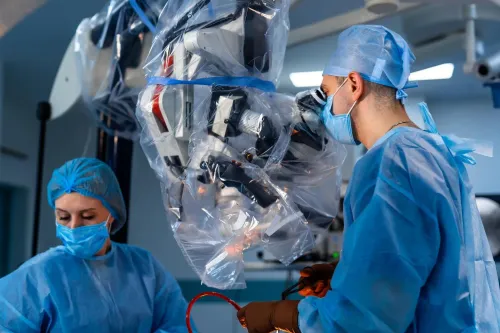
Revision surgery is more demanding than the original knee replacement because removing fixed femoral or tibial components can remove additional bone and damage scarred soft tissue. The surgeon then rebuilds fixation with stems, augments, cones or sleeves; constrained or hinged implants may be needed when ordinary components cannot restore stability.
| Surgical stage | What may happen | Why it matters |
|---|---|---|
| Implant removal | Fixed components, cement, polyethylene, and contaminated tissue are removed | Creates space but can increase bone loss |
| Reconstruction | New components, stems, augments, cones, sleeves, or hinged parts are inserted | Restores fixation, alignment, and stability |
| Infection or damage management | Multiple tissue cultures are collected; an antibiotic spacer, extensor-mechanism repair, or fracture fixation may be required | Determines antibiotics and later treatment |
The team closes the wound carefully and places a drain when bleeding or fluid collection warrants it. Antibiotics depend on cultures, infection findings, allergies, and the reconstruction; thrombosis prevention combines prescribed medication with ankle exercises and early mobilisation.
Pain control supports standing and walking, followed by physiotherapy to regain knee extension, progressive flexion, quadriceps strength, balance, and safe stair use. Walking aids are reduced in stages, while driving, work, sport, and heavier daily activity wait for strength, wound healing, and surgeon clearance.
Recovery and complication risk depend on infection, bone loss, instability, fracture, or extensor-mechanism damage. If you are comparing the best sports doctor for revision knee replacement, ask for results from your specific revision category, not only primary knee-replacement outcomes.
How to Choose a Revision Knee Surgery Doctor in Mumbai
Choose a revision knee surgery doctor by documented revision-arthroplasty experience, not by the label “best sports doctor in Mumbai revision knee replacement after implant problems.” Revision total knee replacement is usually performed by an orthopaedic surgeon who regularly handles complex knee reconstruction; a sports-medicine or arthroscopy title alone does not prove that expertise.
Ask these questions before comparing surgeons:
- How many revision total knee replacements (revision TKAs) do you perform each year?
- What proportion involves periprosthetic joint infection?
- How often do you manage major bone loss, hinged implants, or constrained implants?
- Is an arthroplasty-trained team available for the operation and follow-up?
- Do complex cases involve infectious-disease, microbiology, or plastic-surgery specialists when needed?
| Check | Ask for | Why it matters |
|---|---|---|
| Registration | Entry in India’s National Medical Commission register | Confirms the doctor’s registration |
| Infection testing | The hospital’s synovial-fluid culture laboratory | Shows where aspiration samples are processed |
| Antibiotics | Samples collected before antibiotics when clinically safe | Antibiotics can reduce culture yield |
| Hospital support | Emergency cover and structured rehabilitation | Problems can arise after discharge |
A consultation at One Ortho Clinic with Dr. Viraj Gandbhir is one option to compare with others. Bring the operation report, implant stickers or model numbers, radiographs, culture results, and antibiotic history, then compare the diagnosis, team support, and outcomes for infection, bone loss, instability, or fracture—not only primary knee results.
“Best sports doctor for revision knee replacement” is not a defined medical ranking.
Related service
Revision Total Knee Replacement Revision Total Knee Replacement by Dr. Viraj Gandbhir Revision Total Knee Replacement is a specialized procedure performed to replace or repair a previously implanted knee... View service → |
Frequently asked questions
Which knee replacement implant problems can cause pain or instability?
Loosening, polyethylene wear, malalignment, instability, infection, and a fracture around the implant can cause pain or an unstable knee. Hip disease, lumbar radiculopathy, tendinitis, bursitis, and venous thrombosis can mimic implant failure.
How do doctors confirm the cause before revision knee surgery?
Doctors review your symptoms and previous operative records, examine the knee, and use standing X-rays. Blood tests such as ESR and CRP, joint-fluid testing, and additional imaging help assess infection, loosening, wear, fracture, or malalignment.
When is full revision total knee replacement the right treatment?
Full revision is considered when several implant components are loose, damaged, infected, poorly aligned, or unable to provide stable fixation. Limited component revision is preferable when the remaining components are well fixed, correctly positioned, and compatible with the planned repair.
What happens during revision surgery and recovery?
The surgeon removes affected components, treats infection or bone loss when present, rebuilds fixation, and inserts revision implants that restore alignment and stability. Recovery includes wound care, pain control, progressive weight-bearing, physiotherapy, and monitoring for infection, blood clots, stiffness, and instability.
How should you choose a revision knee surgery doctor in Mumbai?
Ask about revision total knee replacement experience, the likely cause of your implant problem, component-removal and bone-loss strategies, infection protocols, expected rehabilitation, and how complications are handled. Review your scans and operative plan before consenting.
Keywords